A Fabulous Life!

I have read stories of adoptees just showing up at a birth family member’s home: “Surprise! I’m your long lost son/daughter!” {Hugs all around . . . happily ever after . . . blah, blah, blah . . . }  That’s not me.

I had her address.  I looked it up (using the old “Thomas Guide,” if any of you can remember that!).  She lived only 30 minutes away from me.  All this time . . . so close, and yet so far.  I mapped out the directions–wrote it down, even.  But I never made the trip to her house.  Looking back, I guess I was scared.  I figured I already knew what to expect–she could have reached out to me, but she didn’t.  She could have sent a message through Mr. Witt, but she didn’t.  This much was clear: she didn’t want contact with me.

I also knew from the information that I received from Mr. Witt and from the investigator that Margaret had never gotten married and she had never had any other children.

Well, it’s weird to try to explain how that made me feel.  Yes, there was sadness and anger . . . but that passed.  I consider myself a pretty strong person and a pretty good judge of character.  I can process other people’s actions and emotions, as well as my own, and figure out how to fit in.  I feel like I’ve lived most of my life that way: watching and listening to people and trying to figure out how to fit into their world.  So I processed the situation at hand.  My conclusion: Margaret was angry because I had nearly upset her entire world.  I had almost exposed her secret!  Of course, that was devastating to her.  So she lashed out in anger. But here was my problem: her “world” was built around a lie. I am an adult person that exists in this world.  She’s basically denying my existence.  On the one hand, I wanted to respect her privacy.  But on the other hand, I wanted answers.  I was entitled to information.  Was she obligated to give me the information?  Legally, no.

But wait . . . we’re all human beings.  We all have the same basic needs and wants, beginning with our identity.  Most adoptees believe that a moral obligation exists:  a birth mother who chooses adoption should take responsibility for the decision to relinquish a child because the decision changed the identity of another human being. I don’t need ongoing contact–what I need is meaningful communication and information.  Then we can be done.  If that’s the way you want it.

I wrote a letter to Margaret.  I didn’t keep a copy of the letter and it was more than 25 years ago, so I don’t remember exactly what I wrote.  I’m sure I tried to explain my disappointment.  I’m pretty sure I defended my actions (seeking her out).  I’m pretty sure I told her I was “okay” and just wanted to ask some questions.

Margaret responded.  Once again, I was cut to the core.  Shut down.

Her letter came to me, handwritten, on letterhead from The Omni Hotel in South Carolina.  She was traveling.  She got right down to it.

Laureen,

I was surprised to receive your letter–and disappointed.  You need to understand that I strongly feel it was wrong for any records to be opened to you.  To me, it’s more than an invasion of privacy.  I actually feel that by such a disclosure on the part of authorities I trusted, I have been betrayed and violated!

I can’t believe that any good can come from any further contact, and I don’t want to meet or talk, nor to continue a correspondence.  But since you are interested, I will take the time to comment on a couple of things.

Margaret went on to tell me about herself–how she is “strong” and “self-sufficient” and could never be influenced by others.  She has no regrets in life and has lived her life exactly the way she wanted.

Never have I ever done anything that I either felt to be wrong, or later regretted.  As a result, I am well-pleased with my life.  I have a good education and the kind of job most people can only dream of.  So, you see, I have never wondered about you, nor did I expect that you would wonder about me.  I hope that I have now told you enough that you can comfortably let go of your desire for further contact.

Well, that told me nothing.  To be honest, her letter came off to me as defensive and condescending. As if she were defending her actions in life (one of which was giving me up for adoption) and telling me how wonderful her life has been because of it.  She doesn’t need me.  She doesn’t need to know about me.  The closing of her letter said it all.

Got to run.  I’ve got a plane to catch.

Margaret

P.S. Sorry to have left the last name off the address on the envelope, but I tossed your envelope before realizing that your last name was not on the letter.

Wow.  Lucky me.  At least she was able to scratch out a letter to me in between traveling the world for her totally fabulous and fantastic job.  And what great information she provided!  She’s educated, successful, quite pleased with herself, and . . . well, quite pleased with herself.

Not only am I dealing with adoption issues, I am now dealing with narcissism.  Okay, I’m not a psychologist, but really . . . . what would you call it?  Seriously, I am reaching out to this stranger for answers about my identity.  I got nothing useful.  I was even more confused now!  I didn’t write back . . . right away.

The narcissist is governed by his or her feelings, the decent person is governed by his or her obligations” – Dennis Prager

You Can Lie, But You Can’t Hide

We cannot live only for ourselves. A thousand fibers connect us with our fellow men; and among those fibers, as sympathetic threads, our actions run as causes, and they come back to us as effects.
― Herman Melville.

Our lives in this world are defined by our relationships with other people.  Connections we have with family, friends, acquaintances, and even people we don’t know (yet), are what makes us who we are. We are known to others by the way we treat other people, our capacity for empathy and compassion, or lack thereof.

Most people will agree that their relationships with family members are the most important bonds of all.  I agree.  I define family to include not only people related to us by marriage and blood, but also those people in our lives who appreciate having us in theirs. Friends who encourage us to pursue what makes us happy, what is healthy, and what makes us feel whole.  Friends who embrace not only who and what we  are, but also what we strive to be.

I remember my Dad telling me that if I paid attention, I could learn something from every single person I met in life. People can and will teach you life lessons–you just need to be open.  You need to be open to the good and the bad.  You need to be open to the unknown. Sometimes it takes extra effort or courage to allow life’s opportunities and adventures to hit you head on without allowing the fear of the unknown or what you think you know about a particular situation shut you down.

It never occurred to me that my bio mom (I’m more comfortable referring to this way, rather than referring to her as “birthmother”) might not be open to contact with me.  Although I did not expect a “happily ever after” type reunion–she had been through a pretty dark time in her life when I was born, after all. I did hope that there had been enough healing in her life that she would be able to accept me. Or at least acknowledge me,  I mistakenly thought that she’d at least want to hear that I turned out okay–that the family that adopted me loved me and provided a home and environment where I could grow and flourish,

So I waited.  I had given the private investigator a copy of my non-identifying story.  It was pretty easy for the investigator to positively identify and find her. With her last name, my date of birth, and the fact that she had given birth while serving a sentence in federal prison, all the investigator had to do was spend some time at the prison going  through the records around the time of my birth.

Margaret Sue Michaels. Born 12 April 1945 in Chicago.  Arrested August 1963.  Inmate number 0738.  In hospital Dec 15 thru 19th–no reason given.  Arrested at the school she was attending, turned in by her step-father.  Sentenced to 10 years.

Wow.  Turned in by her stepfather.  I remembered the details from Mr. Witt’s non-identifying  report. Margaret didn’t remember much about her “real” father.  According to the story I had, Margaret was very happy with her stepfather.  She felt that “he was all things a father should be.”

So what happened to Margaret after she was released from prison?  The investigator hit a lot of dead ends trying to track her down (it will become apparent a little later why ), so the investigator turned to the information I had provided about Margaret’s half-siblings and other family members to try to make some connections. Those individuals were not so hard to find.

The written report I have from the private investigator chronicles the search, her contact with other family members in an attempt to locate Margaret, and finally, her initial contact with Margaret. Some of the other family members that were contacted were helpful, providing information that would lead to Margaret’s whereabouts.  Some of the family members were not helpful, but not because they didn’t want to help, but because they thought the investigator was on the trail of the wrong person.  The Margaret Michaels they knew didn’t have any children.

It was actually Margaret that contacted the investigator, after receiving a message from a family member that she was looking for her.

Report on phone call from Margaret Michaels, natural mother of Laureen Hubachek: Collect call about 10 am, very angry: “Do not tell me about my daughter, l know all that.  I want to tell you how totally insensitive and unethical it was of you to contact so many people–how many have you contacted?  Tell me, how many!”  I told her I had only spoken to 2 individuals.  One was her mother Eve.  She demanded: “Don’t contact anyone else! I had to do something very terrible!  I had to lie to my mother!”

The investigator reminded her that she had only used public information and records and that if she hadn’t kept her whereabouts unlisted and hidden, she could have found her without contacting anyone else.  That didn’t sit well.  Margaret lashed out: “Maybe that should tell you something!  I didn’t want to be found!”

Margaret went on to explain to the investigator that the social worker, the good and great Mr. Witt, had already contacted her.  Wow!  Impressive!  But Mr. Witt  had to seek her out through other family members, as well as, just like the investigator.  Mr Witt had also contacted Eve.  Eve told Mr. Witt the same thing she told the investigator: “Margaret never had a child.”

Margaret went on to tell off the investigator–lots of colorful words were used. In the report I have, the conversation is described by the investigator as “hostile.”  She indicated that she was considering signing the Waiver of Confidentiality (wait, I thought that was against the rules . . .) and if she decided to contact me, she would do it through the social worker.

Don’t get me wrong, I think it’s fantastic that Mr. Witt went to the trouble to find Margaret, tell her that I was looking for her and that I had signed the Waiver, and  solicit a signed waiver from her.  Honestly, if I had thought that the county social services would provide me with search services for free, I would have never paid money to an investigator to do the job. Remember, the Waiver I signed even says: “I understand that the law prohibits the Department or licensed adoption agency from soliciting, directly or indirectly the execution of such a waiver.”  In fact, I had read plenty of stories about waivers actually being ignored.  Unfortunately, having a “Waiver of Confidentiality” on file is no guarantee that a social worker or clerk won’t ignore it (or be just too lazy to even look at the file to see whether there is a signed waiver in place)  if a birth relative comes looking. There have even been cases where an agency  has had contact from both parties (adoptee and adoptive parent), where the worker or workers at the agency never let either of the parties know they were being sought! The waivers were just sitting in a file!  That wasn’t going to happen to me. I hired the investigator because I wanted to move forward, not just sit and wait.

Well, the investigator called me on the phone to relay all of this information to me initially.  I remember where I was.  I was at work–in an office at my university.  I cried.  I was so frustrated that she was so angry.  How could she be angry?  It was her lie.  Not mine.  What did I do?  Well, I took a step back and waited for a while.  In the back of my mind I thought for sure she’d make contact through Mr. Witt.  She’d cool off and figure out what to tell her family, then sign the waiver.  We’d get to meet (or at least talk on the phone) and I’d apologize for upsetting her.  It wasn’t my intent to be an intrusion or to burst into her life and claim her as my long lost mother.  I had a mother and a father and a whole family that were perfectly fine–great actually.  She had to want to meet me, right?

Wrong.  I never heard again from Mr. Witt.  Or Margaret.  A few weeks after the phone call from the investigator, I received the complete report on the search in the mail, along with a short letter:

Dear Laureen,

At the request of our Director, I am enclosing your birthmother’s address.  The telephone is not available, but we could get it with some expense.

The investigator provided Margaret’s address and confirmed through public records that she was the owner of the home.  Case closed.

How did I feel?  Well, let’s get the obvious out of the way.  Hurt.  Rejected.  But I also felt compassion.  At first I really wanted to apologize to her, if you can believe that!  I wanted to apologize for disrupting her world.  She was angry.  It was my fault.

After a week or so though, I, too, became angry.  I was obviously still hurt, but I came to realize that I did nothing wrong.  It was Margaret that lied (or hid the truth–however she wants to define it).  I realize with Margaret, there was a double whammy of shame and guilt going on back in 1963–not only was she 18 and pregnant, but she was also serving a prison term.  But it had been over 20 years!  There had to have been some soul-searching and healing going on.  You’d think.  Anyway, whether or not she had healed or buried her guilt and shame, lied, was successful in her life, or whether she was living in a garbage bin behind the grocery store–it wasn’t my fault. I still believed that I had a right to information.  Information about my birth, about my ancestry, my heritage, my birthfather and other family members. Medical information, My needs are real  and valid.  I need to know my story.

Well Adjusted? How Do You Really Feel?

I was over the moon with this new information. So many possibilities! I had this entire extended family of aunts and uncles and a maternal grandmother. And I felt that I was getting so close to finding my bio mom. Remember, I had already hired a private investigator who was off and running with my bio mom’s name. I couldn’t wait to get this treasure trove of new “non-identifying” information to the investigator. . . .

Whoa . . . maybe I should slow down here. I’m thinking that before I go any further with my story, I should at least acknowledge all of the different attitudes, emotions and opinions surrounding adoption. This story is filled with emotional roller-coaster inducing twists and turns. Frankly, at times, even I don’t know how to feel. I’ll give it a try. So here’s my basic primer on adoption.

First, there are laws (and they differ from state to state!). Legally, adoption is a statutory process that terminates a parent’s legal rights and duties towards her biological child and substituting similar rights and responsibilities with the child’s adoptive parents. Most states have laws that mandate that the original birth records be made confidential (“sealed”). Confidentiality and sealed records were promoted by authorities as a way to decrease the stigma associated with illegitimacy and to make child welfare the governing rule in placement decisions.

During the 1950’s and continuing through the early 1970’s, there were (and still are to a certain degree) social pressures and growing trends, such as the stigmas on unwed mothers and “illegitimate” children and maternity homes as “warehouses” for unwed mothers, where social workers may have practiced manipulating coercion tactics aimed at convincing young mothers to give up their newborn babies (there was even a name given to this period of adoption prior to Roe v. Wade: The Baby Scoop Era). Finally, there were medical advances (such as “the pill”) and the landmark legal decision of Roe v. Wade, which sparked a national debate on abortion rights that continues today. All of these things can affect in an individual’s attitude about adoption. And there is much more.

I know that when I began my search some 25 plus years ago, I thought I had educated myself pretty thoroughly about the sociology, legalities, and psychology of adoption and I knew exactly what I was feeling. Moreover, I [thought I] knew my rights as an individual. There was a growing movement in many states towards opening adoption records (making available to adult adoptees the original unamended birth certificate). It just made sense–of course a human being is entitled to know his or her birth origins, ethnicity, heritage, biological roots or whatever you want to call it. It is one’s basic identity. And it would be great to have some basic medical history–it gets old writing “NOT APPLICABLE–ADOPTED” on pages and pages of medical history forms year after year.

Another big draw for a lot of adoptees, as simple as it sounds, is the desire to find someone “who looks like me.” Seems kind of trivial, really, given everything my adoptive family gave me. But every single adopted person I have ever spoken to talks about the longing to find out where they got their blue eyes, or their thick hair, or their long legs, or their need to flail their hands wildly when they talk (yes, I wonder where I got it). It’s called biological or genetic mirroring. I didn’t know it had a name until just a few years ago, but it makes complete sense. People who are not adopted may find it difficult to understand, but genetic mirroring is easily understood by an adopted child. In a natural biological family, a child experiences mirroring every day from members of his or her genetic family. It’s almost subliminal how it works. Similarities silently confirm belonging. Everything from physical resemblances to how a parent raises an eyebrow, walks, her tone of voice, his metabolism, his athletic ability, musical talent, artistic ability, physical strength, etc. These genetic markers are fundamental to who we are, providing building blocks for one’s personality to bloom naturally. This all takes place at a subconscious level and is pretty much taken for granted by biological families.

I’m jumping forward a little here, but after the birth of my first child, the genetic mirroring thing became apparent. It was so obvious that my son looked like his father’s side of the family–everyone could see it. And they mentioned it, too. “He looks just like his dad!” It was obvious to me, as well–but what hurt was that he didn’t look a thing like me. Everyone mentioned that, too. I remember staring into his little face for hours trying to compare our noses, the shape of our eyes, chin . . . I got nothin’. As he got older (he’s now 22), his features matured and I can definitely see similarities between us, as well as similar personality traits–just like a “regular” biological family.

Back to adoptees. Generally, adoptees are conditioned from the beginning (assuming they know they are adopted) to be grateful–they were chosen by their adoptive parents. There is usually a story ingrained in them about how their biological parent or parents either were not able or did not want to take care of them. They were saved by their adoptive parents from a life as an orphan. The story is usually meant to comfort the child. But really, it’s kind of scary. On the flip side, as a child gets older and understands a little more about being adopted, it becomes clear that even though they were chosen by one family, they were “unchosen,” or rejected by another. Of course it’s more complicated than that, but in the mind of a child, it’s pretty simple. One result is that the adoptee can be overly focused on the needs of others–adoptees tend to be “people pleasers,” always trying to please other people, especially their parents. After all, the reason we were placed with adoptive parents in the first place was to fulfill their desire to have a child; to make them happy or “whole.” In addition, an adoptee may be fearful (consciously or unconsciously) of being rejected (again). Always walking on eggshells. Always trying to figure out how to fit in.

There are so many theories about what an adoptee should feel: abandonment, rejection, isolation, low self-esteem, grief and trust issues–and that’s just for starters. Some psychologists or adoption “experts” also believe that all adoptees experience a deep physiological and psychological trauma due to the unnatural severing of the tie between the biological mother and child. According to these “experts,” the trauma will stay with the adoptee for the duration of his or her life, together with a deep sense of loss and grief that they are not allowed to mourn. Whoa, that sounds serious. The fact is, being adopted and living a “normal” life as a “well-adjusted” adoptee is much more complicated than one would imagine. And each adoptee feels different.

The truth is, some adoptees will identify readily with some or all of these feelings; others will not. Some adoptees will feel the need to search for their biological family; some will not. There isn’t any one right or wrong way for an adopted individual to feel. Those that do choose to search will have their own reasons. I do believe, however, that any individual, adopted or not, is entitled to know his or her own identity, obtain and possess any legal or government documents that pertain to historical, genetic, and legal identification, including legal name(s) before adoption, place and date of birth; and the identities of biological parents.

Okay. So now you’ve been inside the head of an adult adoptee. Sort of. But to understand the whole picture, you also have to understand the mind of a mother who relinquishes her child to adoption. Well, good luck with that. Just like adoptees, birthmothers come in all shapes and sizes. There are birthmothers out there who believe they made the right decision in giving up their child. There are birthmothers out there who regret their decision. There are birthmothers who claim that they were coerced or shamed into relinquishing their child. Some will even claim that their babies were forcibly taken from them. Some search for their “lost” children and yearn for a reunion. Some do not.

Now you know. Or you don’t. The truth is, you know about as much as I did when I started my search. I promise I’ll be honest about and explain as much as possible my own feelings as I move ahead with my story. Be warned, though, on occasion my own feelings were unexpected. Sometimes I would feel different from one hour to the next. Or one year to the next. As I said before, it’s a journey. I’m still trying to find my way.

My [Non-Identifying] Story

I think Bill Witt went way above and beyond the call of duty in providing the following information to me.  I am grateful that somehow I found him when I did.  I am curious to know about other adoptees (in California or across the country) who have been provided their “non-identifying” information.  Did you receive a story?  Did you receive vivid detail about skin tone, personality, quirks, family members?  Or did you receive some sort of factual outline or listing of non-identifying data? Thank you, Bill Witt, for putting together my story.

Page 1

Page 1


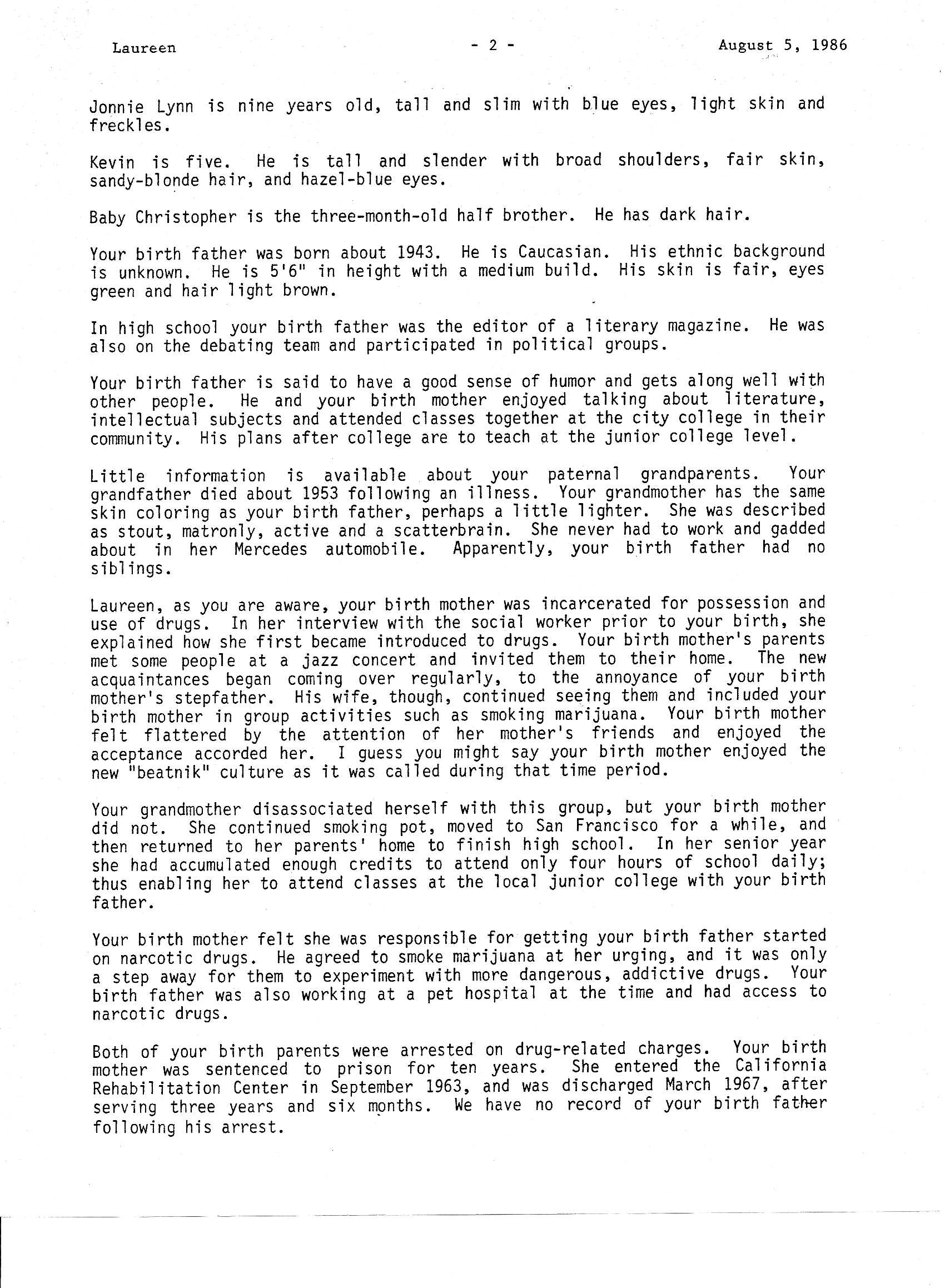
Page 2

Page 2


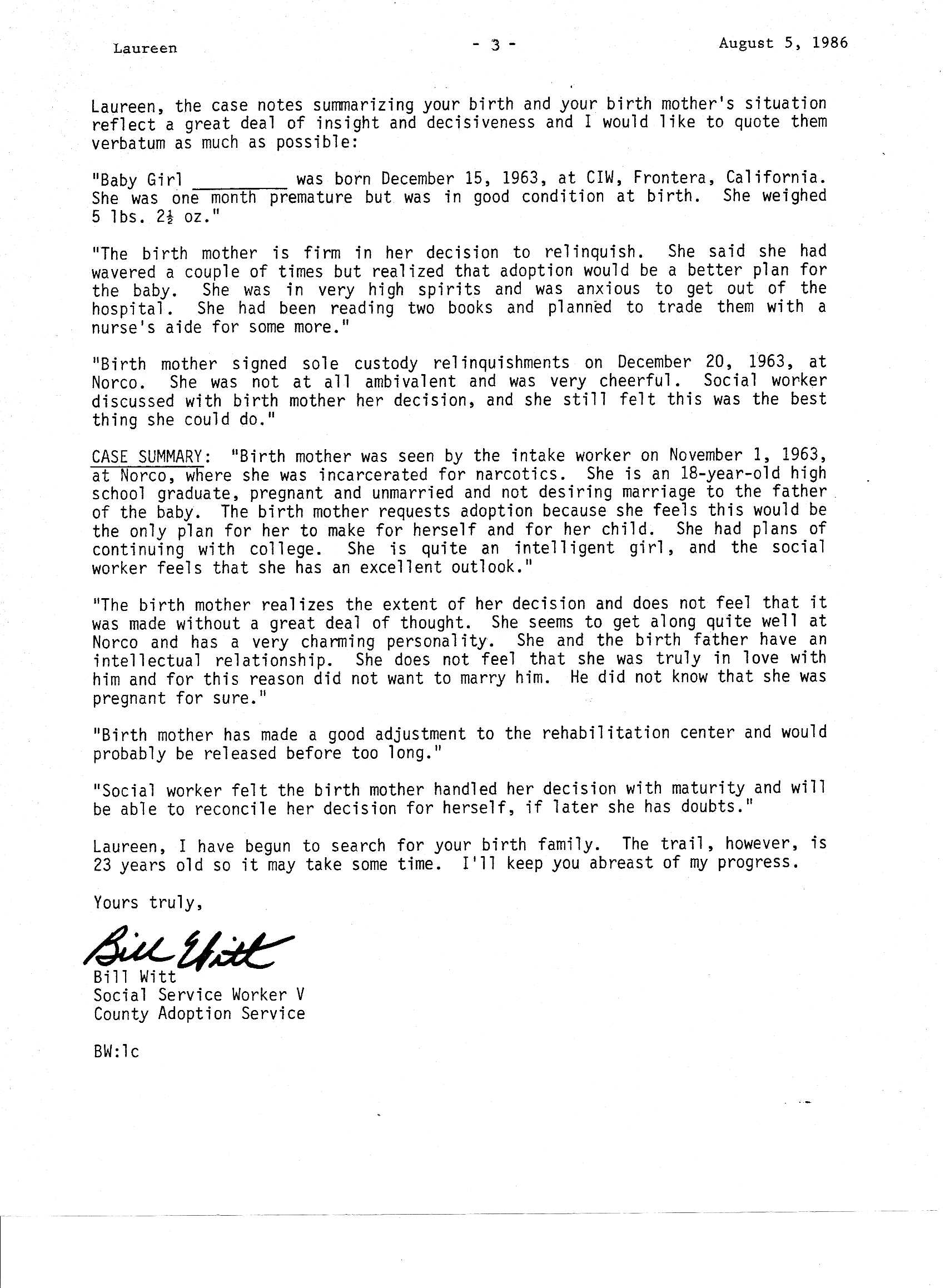
Page 3

Page 3


Good read, right? The information in my non-identifying story provided many more pieces to the puzzle that I was putting together. And there was someone else on the job, as well. In addition to contacting the County Social Services after I got home, I had also contacted the private investigator. She had also begun her search.

The First Pieces of the Puzzle

Sealed records?

Sealed records?

I returned home from the U.K. in the summer of 1986.  I still needed a few more units for graduation, so enrolled once again at my hometown campus.   I found an office job on campus and set to work.  I had done all the research I could do on my end–my parents had given me the “adoption papers” that they had saved all these years that bore my mother’s last name.  Funny . . . I kept hearing over and over about “sealed records,” however, no one mentions that the adoptive parents have copies of the court filings. At least mine did.  I had the first piece of the puzzle: “In the Matter of the Adoption of Baby Girl Michaels.”

This was 1986.  No one owned a personal computer.  “Research” meant a lot of legwork and a lot of phone calls.  I knew I had a right to receive “non-identifying” information from my file stored with the San Bernardino County Welfare Services.  I also knew that the State of California had a mutual consent registry.  A mutual consent registry is a method many states use to arrange the consents that are required for release of identifying information. A mutual consent registry is a means for individuals directly involved in adoptions to indicate their willingness or unwillingness to have their identifying information disclosed. In California, the registry requires consent of at least one birth parent and an adopted person over the age of 18 in order to release identifying information. Consent is given by filing an executed affidavit with the appropriate authority (in my case, the County of San Bernardino) consenting to the release of personal information.

The mutual consent registry still exists in California and in many other states.  With the advancement of technology and the evolution of the internet and its plethora of ever-growing information and databases, we’ve also seen a growing number of private registries, many of which have proven to be successful tools for adoptees and birth parents.  Some charge a fee to register, some do not.

My only option back in 1986, however, was the California mutual consent registry.  I thought I should at least sign a consent and have it on file, on the off chance my birth family is looking for me, right? I called the County Department of Social Services. I spoke to a very nice gentleman named Bill Witt.  I made an appointment to meet with him and to fill out and sign the Waiver for the adoption records.

Waiver - Signed, sealed, delivered.

Waiver – Signed, sealed, delivered.

I don’t really remember everything Mr. Witt and I spoke about on the phone.  I do remember that he asked me to bring a recent photograph of myself so that he would have it on file in case he had contact with my birth mother. I went to the County Social Services Department to meet with Mr. Witt.  I signed the Waiver. I gave him the photo. Then he handed me an official-looking envelope and told me he’d be in touch.  Huh?  He’d be in touch for what?  Surely he wasn’t going to search out my birth mother.  Why would he do that? In fact, the language of the Waiver confirmed, the signing of this waiver does not necessarily insure that a contact can be arranged  . . . the law prohibits the Department or agency from soliciting, directly or indirectly, the execution of . . . a waiver.   I just figured I’d sign the Waiver and it would get thrown in my super-secret “file” somewhere in the basement of the Social Services Department until (or even if) my birth mother decided to sign a Waiver herself. Which I wasn’t expecting to happen. Ever.

I walked back to my car in a daze, grasping the envelope.  Once sitting in the car, I took a deep breath and opened it. Mr. Witt had apparently read my super-secret file. The envelope contained every bit of non-identifying information–in painstaking detail–beautifully written on three pages of County Adoption Service official letterhead.  I was stunned.  Not just by the information he provided, but just the fact that he had gone to the trouble to tell me this story in such beautiful detail.  I’m pretty sure I didn’t even ask for the non-identifying information–I thought that what I already had was better than any non-identifying information he could give me.  I had her last name on the adoption papers.  I was wrong.

I read the story.  Over and over.  Sordid as it was, it was a beautiful story.  It was MY story.  At the bottom of page 3, Mr. Witt wrote: “Laureen, I have begun to search for your birth family . The trail, however, is 23 years old so it may take some time.  I’ll keep you abreast of my progress.”

He was actually going to help me.  Go figure.

Family Ties?

I look back on my childhood with fondness.  I was happy.  My brother and I spent loads of time outdoors during the warm summer months and after school running up and down the block with neighborhood friends.  Middle school (“junior high” back then) was without trauma and actually pretty uneventful.  I muddled through with my two besties.  High school was actually a blast.  I kept my grades up (graduated salutatorian), participated in ASB and student council (senior class president!), and found myself in the middle of normal teenage mischief (ditching class to grab breakfast with friends, vandalizing the rival school’s property before the big game, sneaking out my bedroom window in the middle of the night to hang out with friends . . . wait, that’s not normal?).

I hardly ever thought about being adopted.  It was a non-issue.  So what?  I never “felt” anything but normal.  I can look back now and can clearly see the dysfunction of my family, however.  But it had nothing to do with my brother and me being adopted.  We were no different than most other families.

College was a struggle.  I was the first person in my family to go to college.  My parents were unprepared monetarily to pay for an education or to take on any debt on my behalf.  So I lived at home and enrolled at the local state college, working 30 hours a week to put myself through school. My parents helped out with books and gas money on occasion–they were proud of me, but more than a little perplexed by my ambition.   So, my mother’s reaction to my idea of spending my senior year abroad was no surprise: “Why?”

The California State University system had (and still has) an International Program that affords students the opportunity to study abroad. I have to be honest.  I was thinking less about the academic opportunity and cultural experience, and more about the opportunity for me to finally get out of the house and have the “college experience” that my friends that had gone to a four-year college away from home were already having.  I was ready.

Even though I had 4 years of French under my belt (2 in high school and 2 in college), I decided to make it easier on myself by applying for a program in the United Kingdom. No language barrier would make the studying part that much easier. There were several universities in England that offered  programs in political studies (I was majoring in political science), so I filled out the application and crossed my fingers. There was a selection process–you had to have a high GPA and be able to write an essay about why you wanted to study abroad (I’m fairly certain I didn’t disclose my desire to party in a foreign country and meet guys with hot British accents)–and only a few slots to fill from the entire Cal State system, so I waited on pins and needles to hear the news.

Beautiful Yorkshire

Beautiful Yorkshire

Haworth, West Yorkshire

Haworth, West Yorkshire

I was over the moon when I got the news.  I was headed to the University of Bradford in West Yorkshire!  I had no idea where that was, but it didn’t matter, really.  I had never even gotten on a plane until I was 18 years old–now I was barely 20 years old and leaving the country to live in a foreign land (and go to school) for nearly an entire year!  Turns out that Yorkshire is one of the most beautiful places I would ever ever see.  I was unprepared for the beauty of the Yorkshire Dales and the history surrounding me.  Haworth, the home of the Bronte sisters, is  just north of Bradford–and it’s rich with history and beauty.

A Varley in Bradford

A Varley in Bradford

Imagine my mom’s surprise when I told her the news.  She actually wasn’t at all surprised that I had been chosen; she was surprised that I was headed to Bradford, England.  She couldn’t believe it.  You see, my adoptive mother’s mother’s side of the family is actually from Bradford.  I didn’t know that. Now I did.  That was all my mother could talk about.  She was so excited for me to go over and find some of  “our” family members.  She started pulling out old photos and documents . . . “You must find the Varleys!”

Bell Ringers in Bradford - I assume there's a Varley in there!

Bell Ringers in Bradford – I assume there’s a Varley in there!

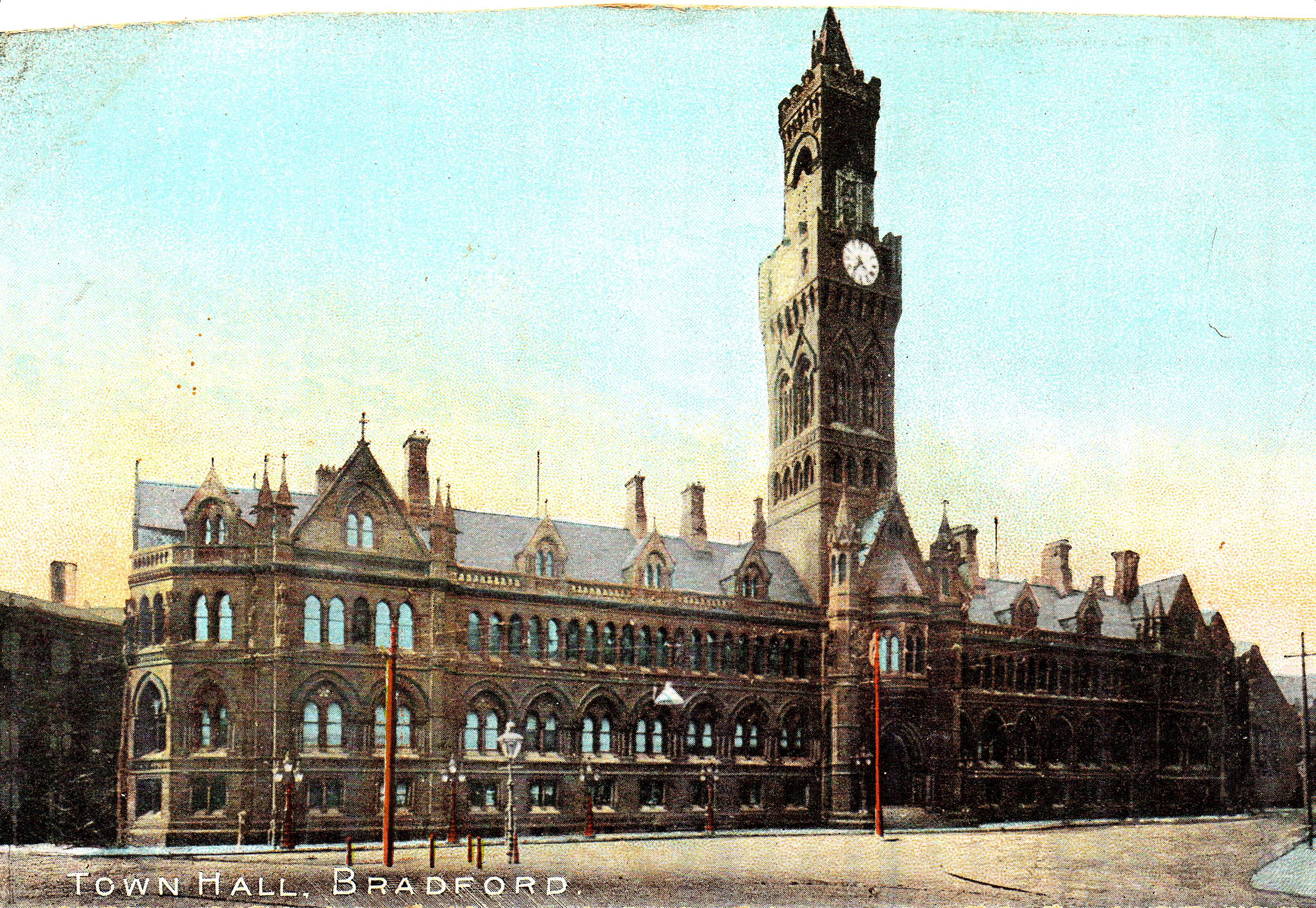
I was really quite impressed with the photos, old documents and postcards she had from back in the day in Bradford.  Even a handwritten record of birth for Samuel Varley born in 1859! Impressive! Even though I didn’t know who Samuel Varley was (nor did I care).

Town Hall, Bradford

Town Hall, Bradford

Seriously, I did not care about the Varleys.  Hello . . . I am 20 years old and I’m heading to a new, foreign land to have the adventure of a lifetime!  And besides, the Varleys aren’t my relatives.  They were her relatives.  I think this was the first time in a long time that I had thought about being adopted.  Was it because I was adopted that I just didn’t care about these Varley people?  Or was it because I was a 20-year-old, self-absorbed young woman who couldn’t wait to flaunt her new found independence (and try some well-hopped pale ale in a real British pub)?

Anyway, once situated in Jolly Ol’ England, I got acquainted with the local pubs, met some fine proper Brits, drank tea with milk, ate some formidable curries, and did a little studying and traveling, of course.

I hiked here!

I hiked here!

It took me a while to work up the enthusiasm to do it, but I did at one point venture to the local post office in Bradford and look up the name Varley in the post and phone directory. Bloody hell!  I was overwhelmed to find pages and pages and pages of Varleys!  What in the world was I supposed to do with this information?  There were no computers to search and narrow down results.  I spoke to my mother over the phone and told her the news.  There were literally hundreds of Varleys in Bradford.  Now what?  That was the end of that.  Even when my parents came to Bradford to visit, the Varley situation didn’t come up.  I think she was just as overwhelmed as I was.

As I said, when my mother started pushing the Varley stuff on me in early 1985, it was the first time in a long time that I thought about being adopted.   And I kept thinking about it even when I was in Bradford.  I wrote to my parents at some point expressing my desire to find my birth parents.  They were supportive.  I even wrote to a private investigator that specialized in adoption cases while I was out of the country. They responded.

We would be thrilled to find your birth parents for you when you get back to the U.S.  We WILL find them.

It was going to be a priority when I returned home.  I will find my birth parents.